
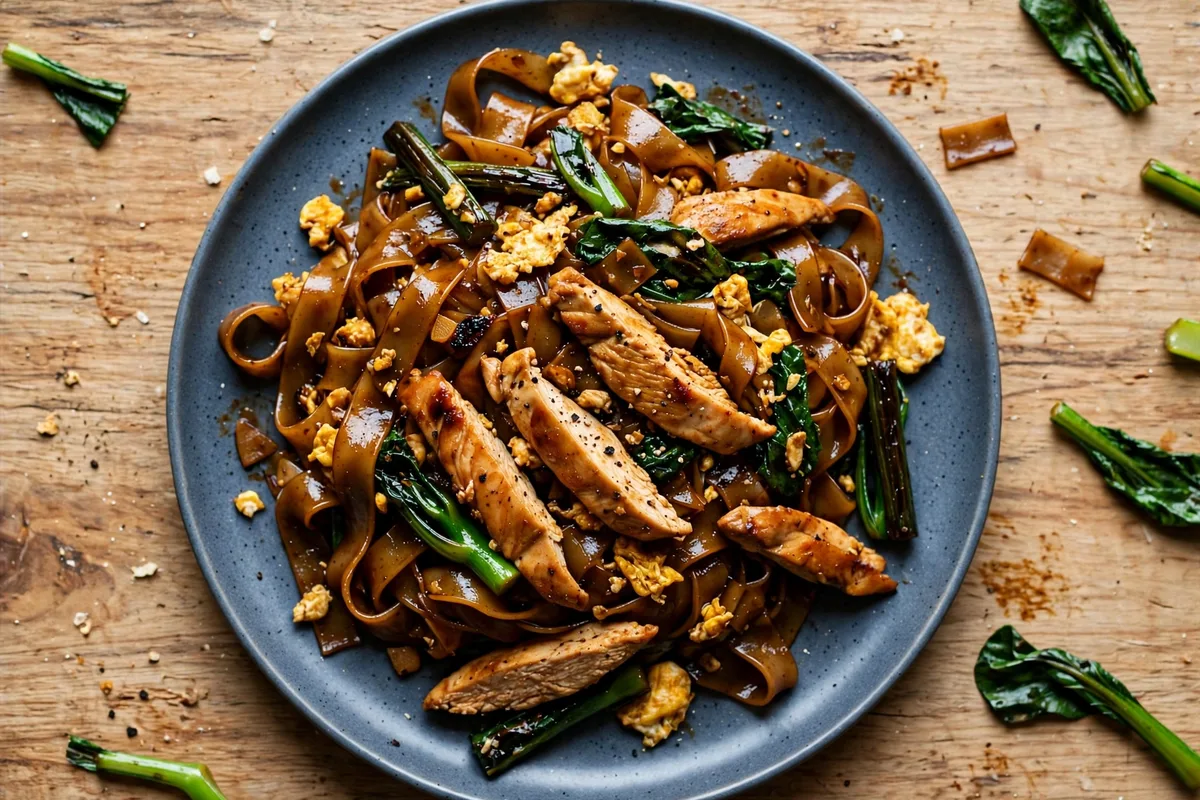
Pad See Ew is Thai comfort food at its most direct: wide, flat rice noodles, charred at the edges, tossed with chicken, Chinese broccoli, and egg in a savory, lightly sweet dark-soy sauce. No tamarind tang, no peanut topping — just smoky, savory noodles that come together fast in a very hot wok.
The keys are a hot pan, noodles that are not over-soaked, and not crowding the wok; cook in batches if the pan is small, and let the noodles sit between stirs to pick up some char.
What is chicken pad see ew?
Pad See Ew is a Thai stir-fried noodle dish made with wide flat rice noodles (sen yai), chicken, Chinese broccoli, and egg, tossed with light and dark soy sauces and a little sugar. The dark soy sauce gives the dish its color and a caramel, savory depth, and the high heat leaves the noodle edges slightly charred.
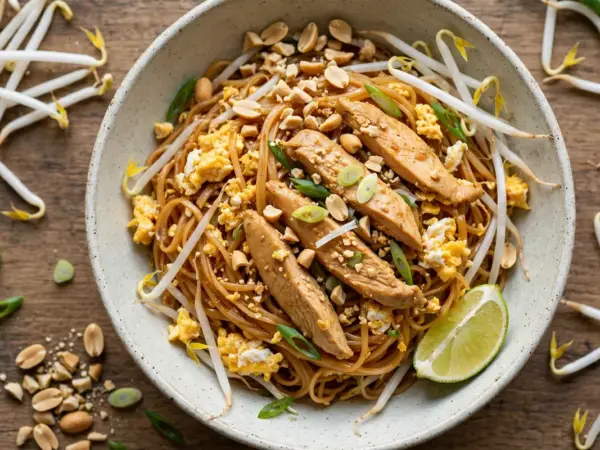
It is different from Chicken Pad Thai, already published on this site. Pad Thai uses thinner rice noodles, a sweet-sour tamarind sauce, peanuts and bean sprouts; Pad See Ew uses wide noodles, a savory dark-soy sauce, and Chinese broccoli.
Why you’ll love this recipe
- Fast weeknight noodles. The stir-fry takes about 15 minutes once the noodles are ready and the sauce is mixed.
- A savory, not sweet, Thai noodle alternative to Pad Thai.
- One wok, little washing up.
- Easy to adjust. Broccolini or regular broccoli can stand in for Chinese broccoli, and the sauce can be made sweeter or saltier to taste.
Ingredients you’ll need
Exact quantities are also given in the recipe card at the end of this article.
- Noodles: 14 oz (400 g) dried wide flat rice noodles (sen yai), or 1 3/4 lb (800 g) fresh wide rice noodles. Soak dried noodles per the packet directions, then drain well — over-soaked noodles break up.
- Chicken: 14 oz (400 g) boneless, skinless chicken breast or thigh, thinly sliced.
- Chinese broccoli: 7 oz (200 g) Chinese broccoli (gai lan), stems sliced thinly on the diagonal, leaves roughly chopped. Broccolini is the closest substitute.
- Eggs: 2 large eggs, lightly beaten.
- Garlic: 3 cloves garlic, thinly sliced.
- Sauce: 2 tablespoons (30 ml) light soy sauce, for the sauce and the marinade; 2 tablespoons (30 ml) dark soy sauce — this colors the noodles; 2 tablespoons (30 ml) oyster sauce; 1 tablespoon sugar, or to taste; 1/2 teaspoon ground white pepper, plus more to serve if liked.
- Oil: 3 tablespoons (45 ml) neutral oil.
- To serve (optional): chili flakes or sliced fresh chili, lime wedges.
Substitutions in brief
For a gluten-free version, use tamari or certified gluten-free soy sauces, and check the oyster sauce label.
How to make chicken pad see ew
Step 1: Prepare the noodles and sauce
Soak dried noodles until pliable but firm, then drain thoroughly. If using fresh noodles, separate them gently and do not tear them. Whisk together the light soy sauce, dark soy sauce, oyster sauce, sugar, and white pepper. Toss the chicken with 1 tablespoon of the light soy sauce.
Step 2: Sear the chicken
Heat 1 tablespoon of oil in a large wok or skillet over high heat until shimmering. Add the chicken in a single layer and cook for 2 to 3 minutes without stirring much at first, until browned. The chicken must reach 165°F (74°C) throughout, with no pink meat remaining. Remove to a plate.
Step 3: Cook the egg and aromatics
Add another tablespoon of oil to the wok. Add the garlic and sliced broccoli stems and stir-fry for 1 minute. Push everything aside, pour in the beaten eggs, and scramble briefly until the whites are fully set, then mix with the garlic and stems.
Step 4: Add the noodles and sauce
Add the remaining oil and the drained noodles. Pour over the sauce and toss gently with tongs until the noodles are evenly coloured. Let them sit undisturbed for 1 minute so the edges char lightly, then toss again. Add a splash of water if the noodles stick.
Step 5: Finish with broccoli leaves and chicken
Add the broccoli leaves and the cooked chicken, and toss for 1 to 2 minutes, until the leaves wilt and everything is heated through and steaming hot. Taste and adjust with more soy sauce or sugar — the sauce is already salty, so taste first.
Step 6: Serve
Divide between four bowls or plates and serve immediately, hot and glossy, with chili flakes or fresh chili and lime wedges if liked.
Tips for the best chicken pad see ew
- Do not over-soak dried noodles. They should be pliable but still firm when they go into the wok.
- Keep the wok very hot. Cook in two batches if the pan cools down.
- Toss gently with tongs. Use a lifting motion so the noodles do not tear.
- Cook the broccoli stems first. Add the leaves at the end so they just wilt.
- Taste before adding extra salt. The light soy sauce, dark soy sauce, and oyster sauce are all salty.
Substitutions and variations
- Gluten-free: Use tamari or certified gluten-free light and dark soy sauces, and a gluten-free oyster sauce; check all labels.
- Vegetarian: Leave out the chicken and sear cubed firm tofu until golden, using vegetarian or mushroom oyster sauce.
- Different greens: Broccolini is the best substitute for Chinese broccoli; regular broccoli also works, with the stems sliced thinly and the florets added with the stems.
- Extra heat on the side: Chili flakes, sliced fresh chili, or chili vinegar.
- No egg: Leave the egg out and add a little extra chicken or tofu.
What to serve with chicken pad see ew
Pad See Ew is a complete main course on its own. A simple cucumber salad or some lime wedges cut through the savory sauce, and chili on the side is welcome.
For a contrast, try Chicken Pad Thai — thinner noodles, tamarind, and peanuts against these wide, dark-soy noodles — or Japchae, the Korean glass-noodle dish.
Storage, freezing, and reheating
- Refrigerate: Cool quickly and refrigerate promptly in an airtight container; eat within 2 days.
- Freeze: Not recommended — rice noodles turn soft and break up.
- Reheat: Reheat only once, in a hot wok or skillet with a splash of water, stirring gently, until steaming hot throughout. Microwaving in short bursts, stirring between bursts, also works but leaves the noodles softer.
Final thoughts
Pad See Ew does one thing well: wide noodles, high heat, a dark savory sauce, chicken and Chinese broccoli, and egg to bind it all together.
If you make it, leave a rating and tell us how you served it. Try Chicken Pad Thai next for the sweet-sour contrast, or Japchae for a Korean noodle comparison.

Leave a review